How to Create Viral History Videos with AI (Step-by-Step)
History is one of the highest-performing faceless niches in 2026. Here's how to use AI to ship cinematic history videos that pull millions of views.
How to Create Viral History Videos with AI (Step-by-Step)
History is the perfect faceless niche in 2026. The audience is enormous, the topics are infinite, the watch-time is high (people stay for stories), and AI visuals have finally caught up to the "cinematic feel" that the genre demands. Channels like Kings and Generals, History Matters, and dozens of newer faceless competitors are pulling millions of views per video.
This guide shows the exact workflow for going from "blank page" to a published, cinematic history video using Tenably AI.
Why history works for faceless
- Evergreen content — a video about Roman roads will get views in 2026 and 2030
- High watch-time — people stay for narratives, which boosts every algorithm
- Authority signals — a deep voice + cinematic visuals reads as "credible," which earns shares
- Sponsor-friendly — every history channel of size has audiobook, course, or museum sponsorships available
- Sub-niche-able — Roman, Medieval, WWII, Ancient Egypt, Cold War, US Civil War — each is its own audience
Step 1: Pick a sub-niche
Don't start as "history." Pick a sub-niche:
- Ancient civilizations (Egypt, Rome, Greece, Mesopotamia)
- Medieval Europe (knights, plagues, kings)
- WWII (battles, codebreakers, untold stories)
- Cold War (espionage, space race, proxy conflicts)
- US Civil War (campaigns, biographies)
- Ancient Asia (China dynasties, Japanese feudal era)
The narrower the sub-niche, the faster the audience finds you and stays.
Step 2: Set the visual style
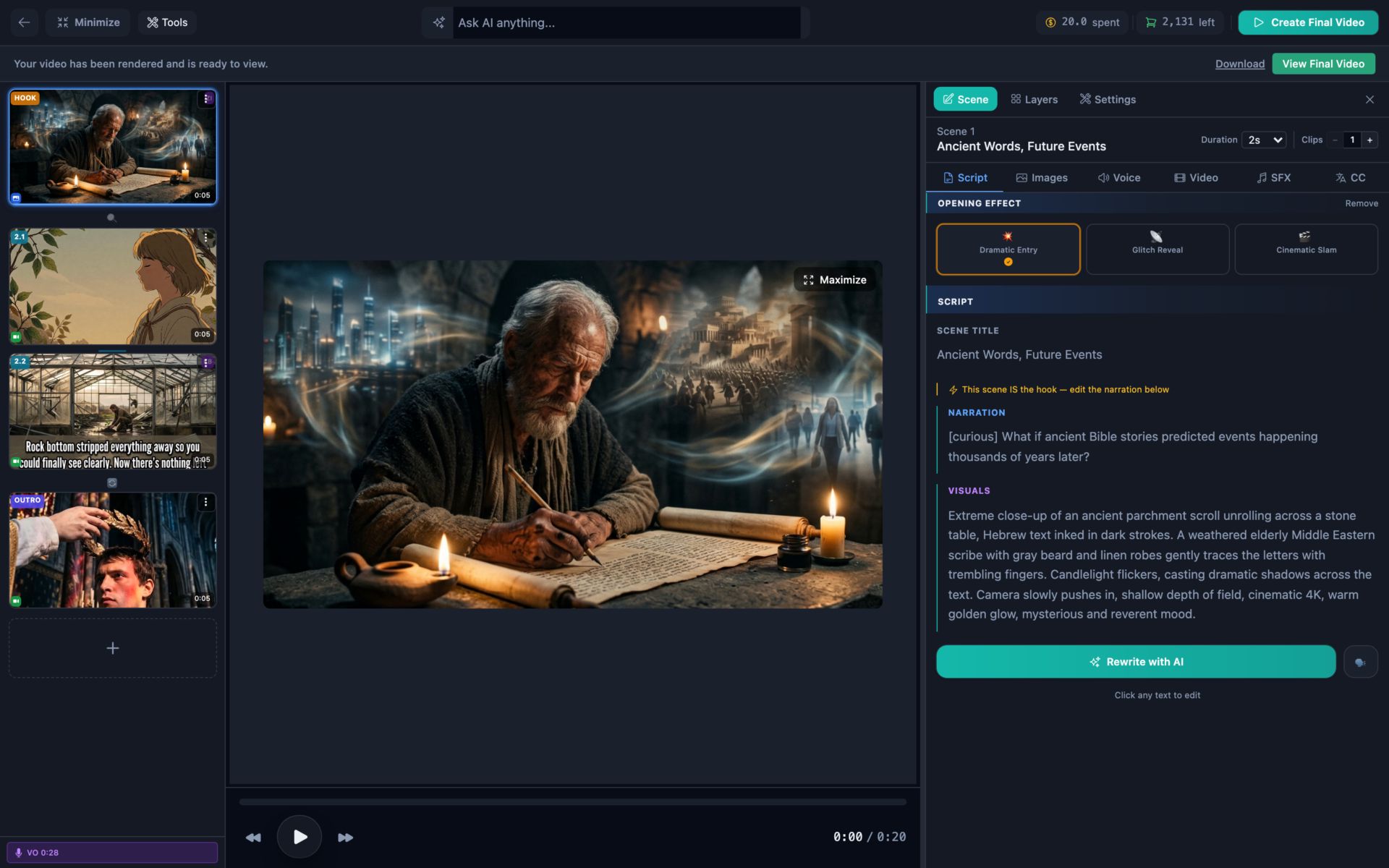
History videos live and die on visual style. In Tenably AI's Faceless Channel flow, the cinematic mode (powered by Nano Banana / Gemini) is built for character and setting consistency across scenes — which is exactly what historical storytelling needs.
For history, the styles that work:
- Cinematic photoreal — for serious narrative (WWII, Cold War)
- Watercolor / painted — for ancient eras (Egypt, Rome)
- Comic book — for action-heavy stories (battles, espionage)
- Sepia photo — for 19th–early 20th century
Pick one and stick with it. Visual consistency is half your brand.
Step 3: Pick a voice
History benefits from a slow, measured, authoritative voice. Tenably AI offers narrator voices specifically tuned for documentary delivery. Pick one, save it as your channel default, and never change it.
Step 4: Generate the script
Topic: "How a single Roman aqueduct kept a city of 1 million alive for 500 years."
Tenably AI's Faceless flow generates:
- Hook: "In 19 BC, Rome had a problem no city had ever solved..."
- Act 1: The problem. Population growth outpacing local water.
- Act 2: The engineering. Aqua Virgo's design and route.
- Act 3: The legacy. Why it still works today.
- CTA: "Comment which Roman wonder you want next."
Each act has 2–3 scenes. The script is timed to a 60-second short or a 6-minute long, depending on which format you picked.
Step 5: Generate visuals scene-by-scene
This is where the cinematic continuity matters. Same Rome. Same lighting. Same architectural style across every scene. The Faceless Video Editor produces each scene with multi-image reference continuity, which is what makes the story feel like a story and not a slideshow of disconnected AI images.
If a scene doesn't land, click swap. New visual in 5 seconds. Don't argue with the editor — just iterate.
Step 6: Add the narration
The AI voice reads the script over the visuals. The Faceless Video Editor lines up scene durations to match narration pacing automatically. You can fine-tune any scene's duration if needed.
Step 7: Music and sound design
History videos need atmospheric music — orchestral, low strings, percussion for tension. Tenably AI's library has documentary-style score tracks tagged for history use. Pick one and it's mixed automatically.
For longer videos, layer in subtle sound design (footsteps, wind, distant battle) — Tenably AI's auto-sound feature suggests these per scene.
Step 8: Caption styling
Captions are non-negotiable for short-form (most viewers watch silent). For history, the styling that works:
- Bold, large text
- High contrast (white with black outline)
- Lower-third placement
- Capitalized for emphasis on key dates/names
Tenably AI applies this style automatically based on the channel preset.
Step 9: Publish to multiple platforms
History works on every platform:
- YouTube Shorts — daily, 30–60s, hook-heavy
- YouTube long-form — weekly, 8–15 min, deep dives
- TikTok — daily, 30–60s, faster pacing
- Reels — daily, 30–60s
- Facebook — daily, slightly slower pacing for older audience
The publisher cross-posts and reformats per platform.
Step 10: Auto-reply to drive comment volume
History audiences are commenters by nature — they correct dates, add context, ask follow-ups. Lean into that. Auto-Reply Engagement drops a strategic first comment ("which empire built this best?") and replies to every comment in your channel's voice.
A single history Short with 1,000 comments gets shown to 100x more people than one with 10. Auto-reply is the difference.
Step 11: Re-release winners
History content is especially re-releasable. The same Roman aqueduct video can be re-titled as:
- "The Engineering Marvel That Saved Rome"
- "Why This Aqueduct Still Works After 2,000 Years"
- "The 500-Year Roman Water System You've Never Heard Of"
AI Re-release Engine does this automatically — new title, new thumbnail, new opening scene — and re-publishes. Same content, multiple paydays.
Step 12: Monetize
A mature history channel stacks:
- AdSense (long-form especially)
- Audible / book affiliates in description (huge in history audience)
- History course / Masterclass affiliates
- Channel-branded merch (maps, prints) once audience is loyal
- Sponsorships from history-adjacent brands (museums, documentaries, history apps)
Channels like Kings and Generals monetize at $8–15 per 1,000 views all-in. A 500k-view video earns $4–7k.
What success looks like
A typical Tenably AI history channel after 90 days of daily posting:
- 50k–150k followers on TikTok or Shorts
- 1–3 long-form YouTube uploads pulling 100k–500k views each
- $1,500–5,000/month in combined revenue
- Inbound sponsorship inquiries from history-adjacent brands
Scale by adding sub-niches: spin up a "WWII" channel after Roman history is autopiloting.
Try a history channel
Tenably AI's Faceless Video Editor with cinematic mode is included from $24/mo. Cancel anytime.
More in Faceless
How to Make Viral TikTok Videos with AI in 2026 (No Filming Required)
You don't need a camera, a face, or editing skills. Here's the exact AI workflow we use to ship 10 TikTok videos in an hour.
AI Video Generator for YouTube Shorts and Long-Form Channels
How to use AI to ship a YouTube channel — Shorts daily, long-form weekly — without filming or editing yourself.

How to Make Faceless Videos for Facebook, TikTok, and YouTube in 2026
Faceless videos are the biggest creator opportunity of 2026. Here's the exact workflow — script, visuals, voice, publish — using AI from start to finish.