How to Find Local Business Leads on a Map (AI Lead Prospector Guide)
Your next 100 customers are within 5 miles and don't know you exist. Here's how to find them, score them, and outreach using AI.
How to Find Local Business Leads on a Map (AI Lead Prospector Guide)
If you sell B2B services to local businesses — marketing, accounting, IT, cleaning, supplies, you name it — your next 100 customers are within 5 miles of your office and don't know you exist. The hard part isn't converting them. It's finding them in a structured way.
This guide walks through using Tenably AI's Lead Prospector to systematically discover, score, and outreach to local business leads.
Why most small businesses skip prospecting
Three reasons:
- It feels like cold-calling. It doesn't have to be — done well, it's research-driven outreach.
- There's no obvious tool. Apollo and ZoomInfo are built for enterprise sales teams, not local service businesses.
- It's hard to know who's worth pursuing. A "list of local restaurants" is not a sales motion. A "list of local restaurants with weak online presence and money to spend" is.
Lead Prospector is built specifically for the third problem.
What Lead Prospector does
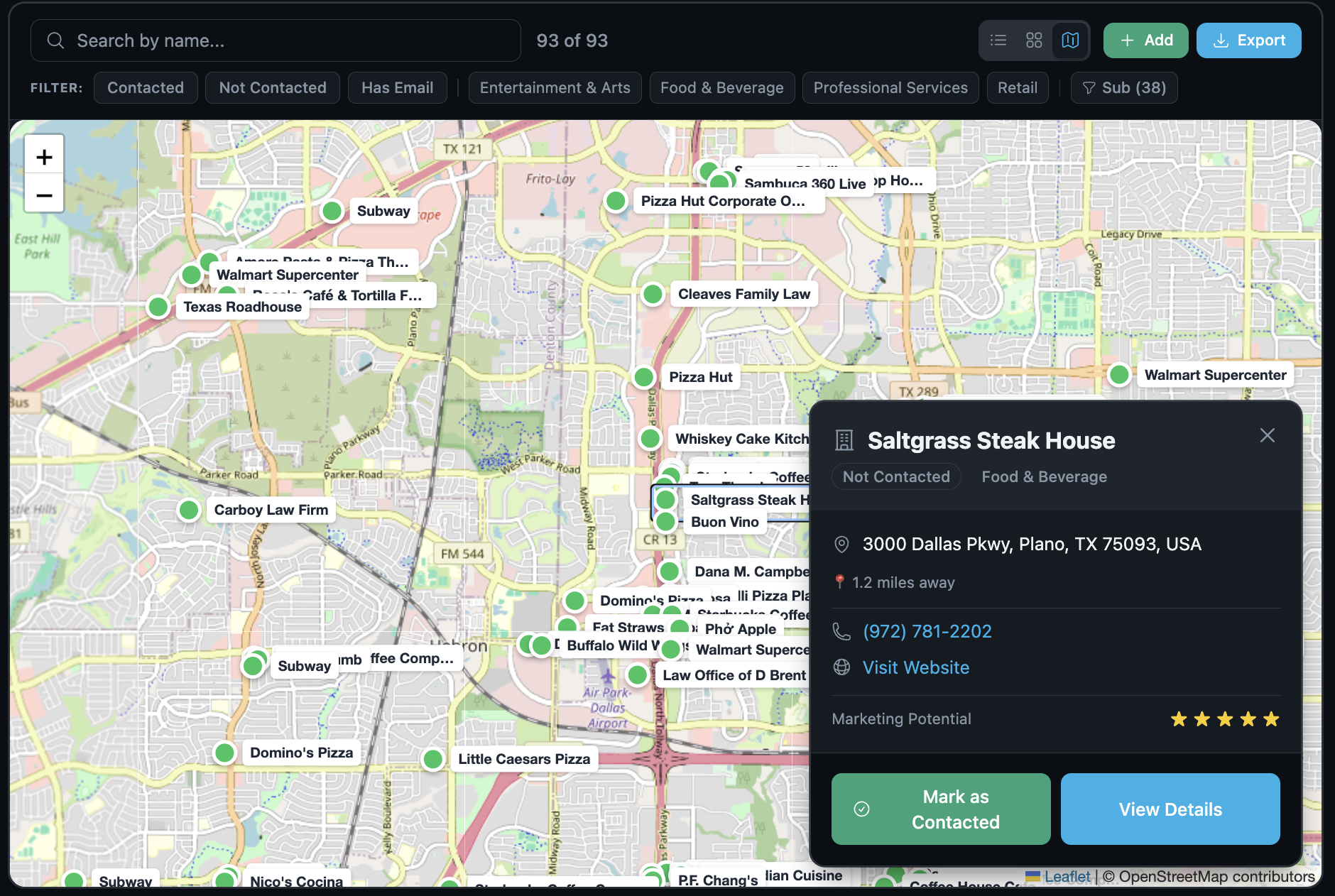
Open Tenably AI's Lead Prospector and you see:
- A map of your area with every local business pinned
- Filters by category, distance, rating, review count, etc.
- Marketing potential scores per business — an AI-generated 1–100 score based on signals like:
- Their current online visibility (rating, review count, social activity)
- Their estimated business size (employees, locations)
- Whether they're missing obvious things (no website, dead Instagram, no GBP photos)
- Industry-typical revenue benchmarks
- Contact info for each business — phone, website, email where available
A high-score lead = a business with money but a weak online presence. That's your ideal prospect.
The 3-tier prospect framework
Every lead falls into one of three tiers:
Tier 1: "Bleeding visibly"
- 0–10 Google reviews
- Average or low rating (under 4.0)
- No or minimal social presence
- Looks small but operating
Why they're great: they need help and know it. Easy to start a conversation. Lower price point but high close rate.
Tier 2: "Doing okay, but leaving money on the table"
- 30–80 reviews
- Solid rating (4.2–4.6)
- Some social presence, inconsistent
- Established business, decent revenue
Why they're great: they have budget, they're not desperate (good — desperate buyers churn), and they understand the value of marketing. Sweet spot for retainers.
Tier 3: "Already winning"
- 100+ reviews
- 4.7+ rating
- Active social
- Likely already has marketing help
Why to skip them (mostly): harder to displace incumbent vendors. Not worth the prospecting effort unless you have a specific differentiator.
Lead Prospector's marketing potential score roughly maps to Tier 1 (80–100), Tier 2 (50–79), Tier 3 (0–49). Filter accordingly.
Building a prospect list
Open Lead Prospector and:
- Set radius — start at 5–10 miles for local services
- Set category — pick your target (restaurants, dentists, gyms, contractors, etc.)
- Filter by score — Tier 1: 80+, Tier 2: 50–79
- Sort by relevance / score
- Export the list — Tenably AI exports CSV with name, contact, score, and qualifying reasons
A typical 10-mile radius gives you 50–200 qualified leads.
Outreach: keep it specific
Generic "I do marketing, want help?" emails get ignored. Specific outreach gets responses.
The structure that works:
Subject: 3 things I noticed about [Business Name]'s online presence
Hi [Owner Name],
I was researching [their category] in [their city] and noticed [specific observation — "your last Instagram post is from 2023" or "you have a 4.7 rating but only 14 reviews"].
If it'd help, I put together a quick 90-day plan to [specific outcome — "100+ Google reviews" or "daily social posts on autopilot"]. No pitch — just sharing what I'd do.
Want me to send it over?
[Your Name]
Response rates on this template typically run 8–15% — extraordinary for cold B2B outreach.
Scaling outreach without sounding like a bot
A few rules:
- Reference something specific about each business — Lead Prospector shows you "missing GBP photos" or "no Instagram activity" exactly so you can reference it.
- Don't pitch in email 1. Offer value first ("here's a 90-day plan").
- Cap volume at 30–50 emails per day per inbox. Anything more triggers spam filters.
- Use a real person's email, not info@yourbiz.com.
- Follow up twice — week 1, week 2, then leave it.
Combining with content marketing
The unfair advantage: Lead Prospector lists become content fuel for your social channels. Examples:
- Pick a Tier 1 prospect, do a free "audit" video for them, post it on your social
- Build a series: "I audited 10 [category] in [city] — here's what they're all missing"
- Tag the prospect in the post (if appropriate)
This turns prospecting into inbound. Half the prospects on your list end up DMing you.
What success looks like
A typical Tenably AI B2B customer running Lead Prospector for 90 days:
- 200–500 leads identified
- 60–80 personalized outreach emails sent
- 8–12 responses
- 3–5 closed clients
- $3k–15k MRR added
The ratio depends heavily on your offer and price point — but the process is the same.
Try Lead Prospector
Lead Prospector is included in every Tenably AI plan. Plans from $24/mo, cancel anytime.