Best AI Marketing Tools for Small Business in 2026
A practical comparison of AI marketing tools — what each is good at, what they're missing, and how to pick the right stack for a small business.
· Updated
Best AI Marketing Tools for Small Business in 2026
The AI marketing space exploded in 2024–2025, and by 2026 it's a mess. Every tool claims to "automate your marketing." Most do one thing well and leave you stitching together five subscriptions to get a complete workflow.
This guide is an opinionated breakdown — what AI marketing tools actually do, what they miss, and how to pick a stack that doesn't bankrupt you. If you only need the social piece, start with our pick for the best AI social media manager for small business; every tool named below is compared head to head on the compare page.
What "AI marketing" actually means
Before tools, get clear on the jobs:
- Content generation — text, images, video
- Publishing — to social platforms
- Engagement — replying to comments and DMs
- Reputation — Google reviews, response automation
- Lead generation — finding new customers
- Email — sending and designing campaigns
- Analytics — knowing what's working
Most "AI marketing tools" do 1 or 2 of these. The few that do all of them are rare.
Categories of tools you'll see
Content generation (text only)
ChatGPT, Claude, Jasper, Copy.ai. Great for writing captions and emails. Weak at images, video, or publishing. Best for: writers and content marketers who already have a publishing workflow. Missing: publishing, engagement, reviews, lead gen.
Image generation
Midjourney, Adobe Firefly, Canva (with AI). Beautiful images. Best for: designers and brands that need bespoke visuals. Missing: captions, publishing, engagement, anything past the image.
Video generation
Runway, Pika, Synthesia, Sora-class models. Generate video clips. Best for: specialists who edit elsewhere. Missing: scripts, voice, publishing, scenes that connect, social workflow.
Faceless video platforms
Pictory, Invideo AI, Vidnoz, Tenably AI (Faceless Channel Empire). Generate end-to-end faceless videos. Best for: creators and small businesses building social presence without filming. Missing (in most): publishing, engagement, monetization mix, multi-channel orchestration.
Social schedulers
Buffer, Later, Hootsuite, Sprout Social. Schedule posts to multiple platforms. Best for: teams that already create their own content. Missing: content generation, AI engagement, reviews.
Review management
Birdeye, Podium, NiceJob. Collect and respond to reviews. Best for: local businesses focused on reputation. Missing: content, social, lead gen.
Lead generation
Apollo, Clearbit, ZoomInfo. Database of business contacts. Best for: B2B sales teams. Missing: content, social, reviews.
All-in-one platforms
HighLevel, HubSpot (with AI), Tenably AI. Try to do many of the above. Best for: small businesses who don't want to stitch tools together. Missing: depth in some areas (HighLevel in content, HubSpot in faceless video).
What a small business actually needs
For 90% of small businesses (5–50 employees, local or e-commerce), the workflow that wins is:
- Daily social content generated with AI (text + image + video)
- One-click cross-posting to Facebook, Instagram, TikTok, YouTube
- Auto-reply to comments and DMs in brand voice
- Automated review collection and response
- Email campaigns triggered by behavior
- Lead prospecting for net-new customers
- One dashboard to see what's working
Stitching that together with separate tools costs $500–1,500/month and creates 5–7 places where work falls through the cracks.
How Tenably AI compares
We're biased — Tenably AI is the platform we built. The shape of it:
- Content generation: AI Post Ideas, Image Studio, AI Flyer Maker, AI Video Studio, Faceless Video Editor (cinematic continuity), Daily Image Posts
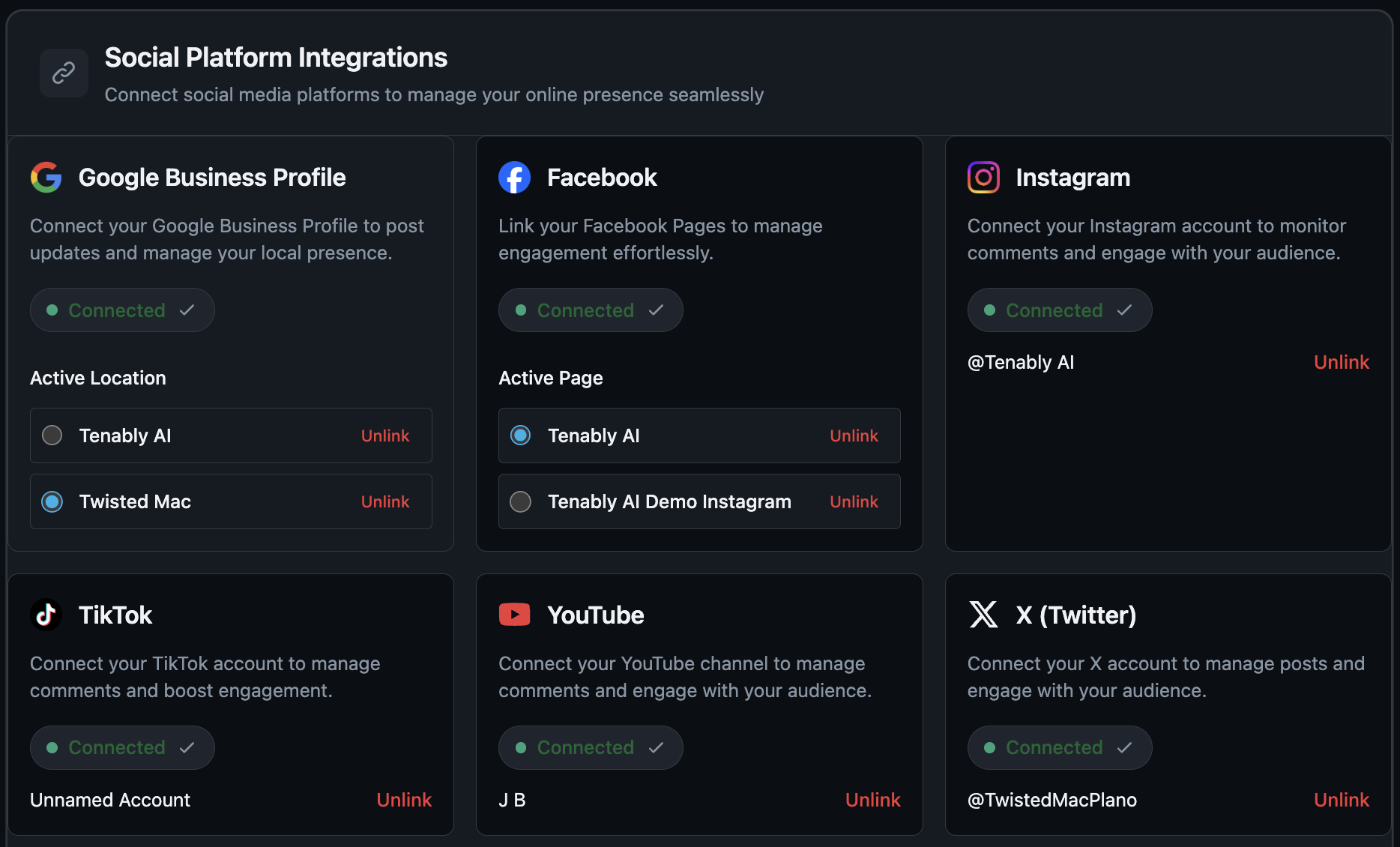
- Publishing: one-click cross-post to FB, IG, TikTok, YouTube, X, with auto-formatting per platform
- Engagement: Auto-Reply Engagement (24/7 in brand voice + strategic first comments)
- Reputation: Smart Review Collection, AI Review Responses, Review Trends, Competitor Intelligence
- Lead generation: Lead Prospector (map view of local businesses with marketing potential scores)
- Email: AI Email Campaigns (full design from a topic prompt)
- Faceless income: Faceless Channel Empire, Re-release Engine
- Reporting: Command Center + Social Analytics
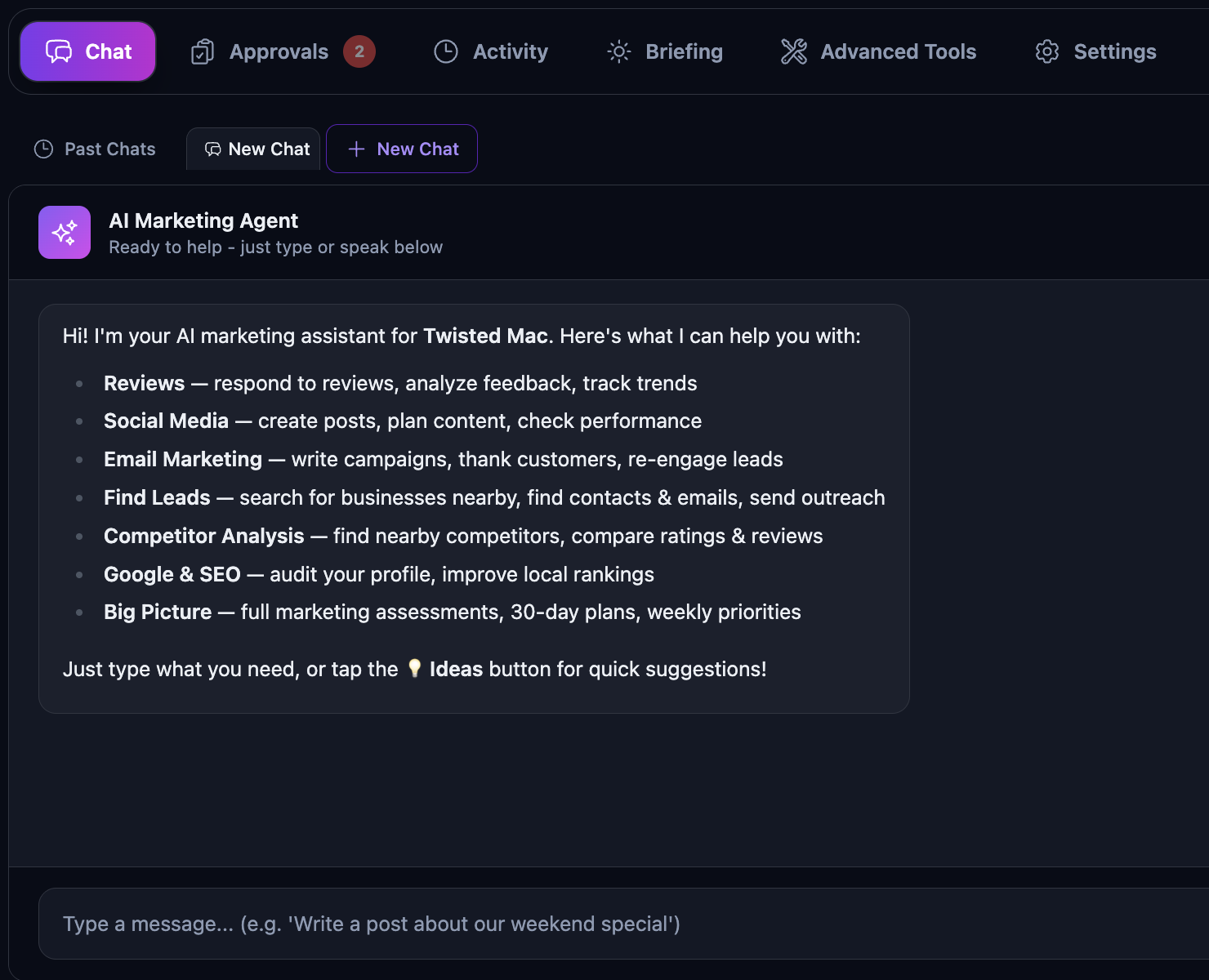
- AI agent: AI Marketing Agent (chat-based assistant that knows your business)
What it's not great at:
- Long-form blog SEO writing (use Claude for that)
- Programmatic ad buying (use Meta Ads Manager / Google Ads directly)
- Deep CRM workflows (use HubSpot or HighLevel for sales-heavy ops)
How to pick the right stack
If you're a local service business: Tenably AI handles 90% of what you need. Stitch in your CRM (Jobber, ServiceTitan, etc.).
If you're an e-commerce brand: Tenably AI for organic + reviews + content. Add Shopify + a paid ads tool. Klaviyo if you've outgrown Tenably's email.
If you're a faceless creator: Tenably AI's Faceless Channel Empire is built for you. Add nothing.
If you're a B2B SaaS company: Tenably AI for content + social + reviews. Add Apollo or Clearbit for outbound. HubSpot for CRM.
If you're a personal brand / creator: Tenably AI for content + engagement + monetization. ConvertKit or Beehiiv for email if you're newsletter-heavy.
What you should NOT do
- Don't buy 5 specialized tools. Stitching breaks. Pick a platform, stretch it.
- Don't pick "the cheapest one." AI marketing tools that are too cheap usually skimp on the part that actually drives revenue (engagement, reviews, lead gen).
- Don't pick a tool with no real human in the loop. Auto-reply that can't escalate to you = brand damage.
- Don't pick a tool without analytics. If you can't see what's working, you're guessing.
Try the all-in-one stack
Tenably AI bundles content, publishing, engagement, reviews, lead gen, email, and reporting into one platform. Plans from $24/mo, cancel anytime.